Why Data Centers Are Now Part of Michigan's Energy Debate
Large data centers can use as much electricity as a small city. As more are proposed in Michigan, they are reshaping how the state plans for power, land, and local infrastructure costs.
New here? Start with the basics →
Why data centers matter in Michigan now
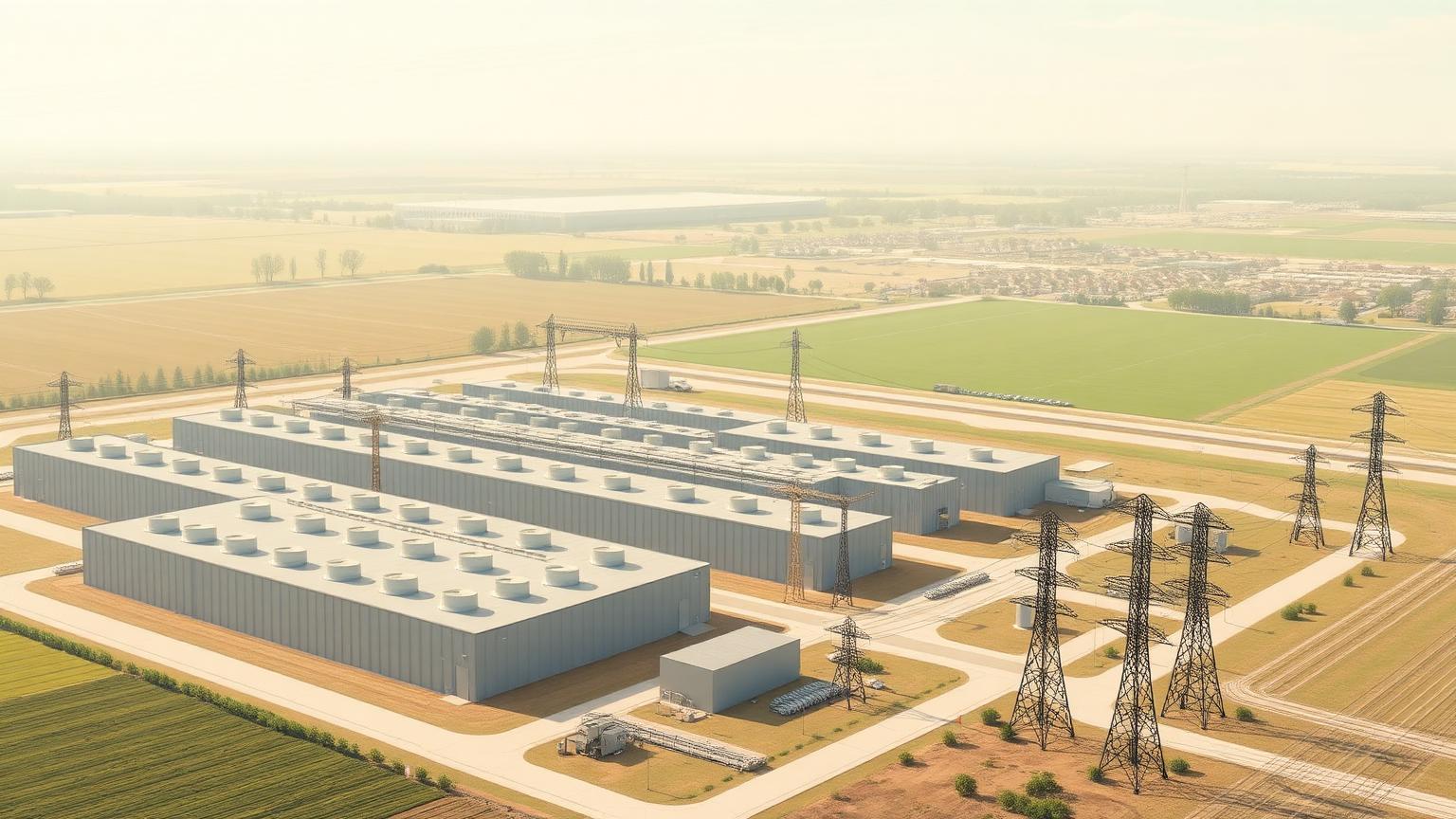
Data centers are large industrial buildings full of computer servers that power cloud services, websites, AI models, and business software. Most use a lot of electricity around the clock and significant cooling.
Michigan reporting in 2026 has flagged data centers as a major new driver of electricity demand growth in the state. One analysis cited locally projects data centers could account for about 40% of Michigan electricity demand growth by 2030 in a mid-growth scenario, and up to ~57% in a high-growth scenario.
How much electricity they can use
A single hyperscale data center can draw hundreds of megawatts — sometimes a gigawatt or more across a campus. WKAR reported in 2026 that DTE's data-center pipeline alone could equal more than 4 gigawatts, raising significant questions about how much new generation, transmission, and storage Michigan will need to serve that load.
For comparison, a typical Michigan home uses around 0.001 MW on average. A single 500 MW data center is roughly equivalent in continuous demand to a few hundred thousand homes.
Why they are linked to grid expansion
Adding gigawatts of new round-the-clock load typically requires:
- New or upgraded transmission lines and substations.
- Additional generation — a mix of natural gas, nuclear, wind, solar, and storage.
- Battery storage and other balancing resources to handle peak demand and outages.
Michigan's March 2026 MPSC storage order even tied some approved battery projects to a major data center development in Saline Township, Washtenaw County — a concrete example of how data center load and storage planning are now intertwined.
Local concerns: land, noise, water, backup generation, and taxes
- Land & siting. Data centers are large industrial buildings. Where they go matters for traffic, neighbors, and surrounding land uses.
- Noise. Rooftop chillers, fans, and outdoor cooling equipment can be a continuous noise source for nearby residents.
- Water use. Some cooling designs use significant water; others are largely air-cooled. The design choice is a fair public question.
- Backup generation. Most large data centers include diesel or natural gas backup generators. Air-quality limits, runtime caps, and testing schedules deserve scrutiny.
- Tax incentives. Promised job and tax-base numbers should be checked against the abatements granted and the long-term local cost of upgrades.
Who pays for upgrades
One of the most important Michigan questions right now is whether existing utility customers — homes, farms, and small businesses — could end up paying for grid upgrades that primarily serve large data-center loads.
That is fundamentally a regulatory question, decided through MPSC rate cases and tariff design. The principle most consumer advocates push for is straightforward: large new loads should pay their fair share of the costs they cause.
What residents and local governments should ask
- How much electricity (MW) is the project requesting, and over what timeline?
- What grid upgrades will be required, and who is paying for them?
- What is the cooling design — air-cooled, water-cooled, or hybrid — and what is the projected water use?
- How many backup generators, what fuel, and what air-permit limits apply?
- What sound levels are projected at the property line and at the nearest homes?
- What tax abatements, PILOT agreements, or other incentives are being requested, and what are the long-term local costs?
How data centers connect to battery storage and power planning
Large new data-center loads are one of the main reasons Michigan utilities are now adding so much new battery storage and pursuing additional generation. Storage helps absorb solar and wind output when it is plentiful and discharge it during the high-demand hours that big loads create.
For more on the storage side, see our Battery Storage in Michigan page.
Related: Battery Storage · Sources